

Throughout his career, Charlie Fultz has faced many challenges. Few years, however, were as difficult as this past golf season has been at Heritage Oaks Golf Course in Harrisonburg, Virginia, where he is general manager and superintendent.
"This has been the second-hardest year of my career," Fultz said.
"It was a tale of two seasons. It was wet in the spring, then it was wet and hot during the summer. I shortened my spray intervals to every three weeks, and I still lost turf. I couldn't dry the place out. Even with all our drainage we got smoked. You could just watch the water run across the fairways."
What in the world throughout his career as a superintendent could have been worse than that?
"In 1998 I almost got fired," he said. "That was the hardest year I've faced. I questioned my existence. I went to my GM, and he told me I had just survived a board vote of 5 to 4 the night before."
This was a wild year weatherwise. It was a rainy spring, then a drought by summer.
The 2025 golf season was a challenging one for many superintendents.
Too much rain early in the season, too little rain and too much heat late in the summer were the catalysts for a variety of challenges for many superintendents.
Kevin Moores of Oakfield Golf and Country Club in Enfield, Nova Scotia was plagued by a lack of rain through the summer.
"A major lack of rainfall over the last 8 weeks has had us chasing wilting turf in a way that has not been seen here in years," Moores wrote in August through social media. "The average rainfall totals from June 8th (the last time we had a significant precipitation event) through August 6th is around 200mm rain. To date we have received approximately 35mm of rain, which is about 17% of the average over this timeframe."
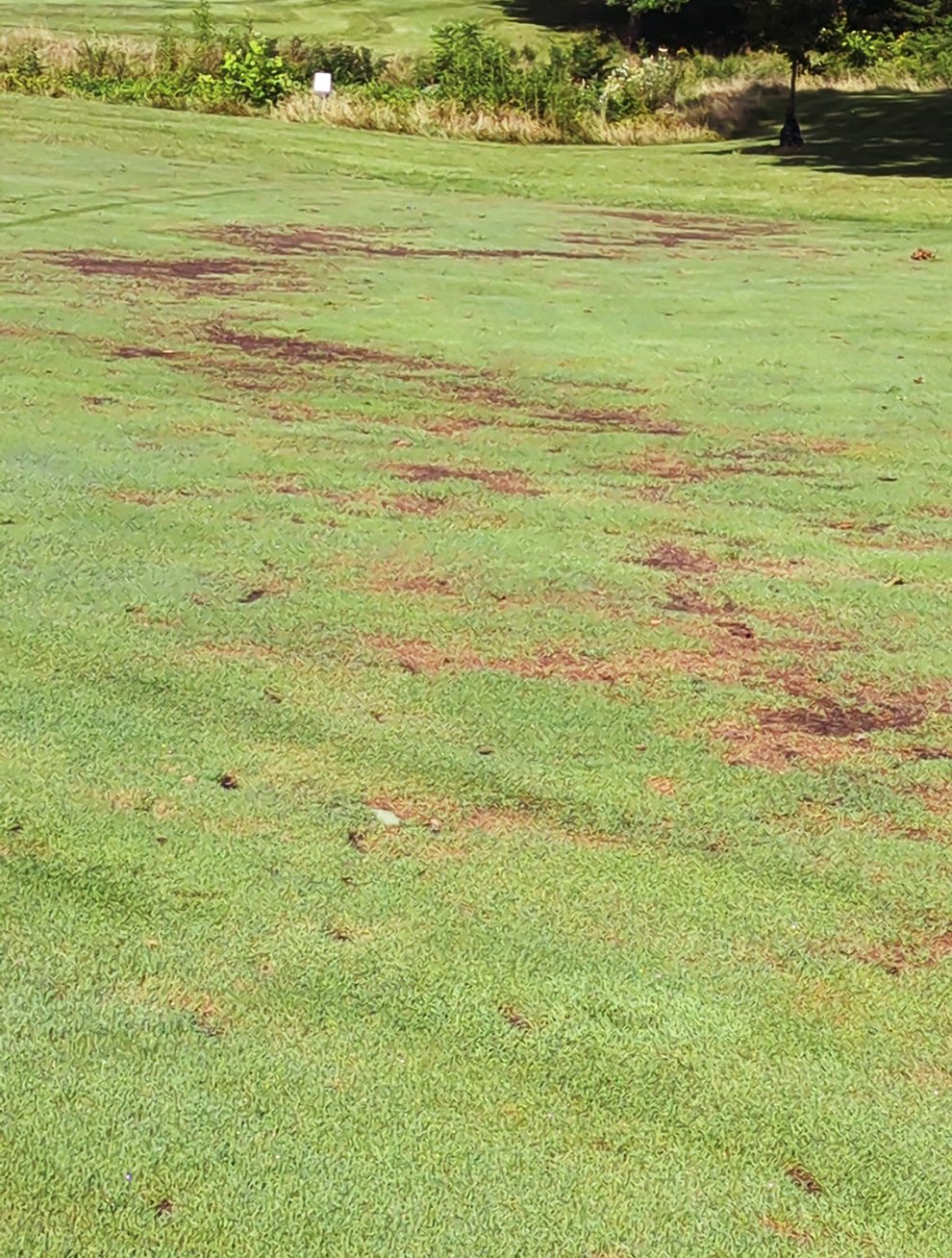 In Virginia, rain fell for three consecutive days in July at Heritage Oaks (right), which received 8 inches in three weeks after Independence Day. As quickly as the rain fell, it went away just as fast, as conditions turned to bone dry by August.
"The wind was blowing every day, and I think I was curled up in my office in a fetal position," Fultz said. "I stopped PGR use to try to get fairways to heel."
It was equally unpredictable in western Tennessee at Persimmon Hills Golf Course, a daily fee where Steven Scott is owner and superintendent.
"This was a wild year weatherwise," Scott said. "It was a rainy spring, then a drought by summer. Then the winter weather we had at the beginning of the year. Ice, snow, hot, cold; we saw it all. Now, we've got Poa popping everywhere because the temperatures have been on a see-saw in October and November."
Scott's corner of Tennessee received about 30 inches of rain from April through July, then none in August, according to the National Weather Service. That total was about 10 inches above the normal average, according to NWS.
"Everybody here said this is the most rain we've ever had, then in August they said it was the driest it's ever been," he said. "If you look at the numbers, it's about average. We just got it all at one time."
Problematic for Scott was much of that rain came on weekends, which was a drag on play — and revenue. It also was a downer for golfers. The course in Sharon, Tennessee is one of just a short list of options in that part of the state and has a core group of dedicated golfers.
"It seemed like it rained every Saturday and Sunday, which, of course, is when most of your golf is played," he said. "That was a problem, but I think the golfers, it affected them more."
Excessive heat was an issue up and down the East Coast in the Philadelphia area as well as in the North Carolina Piedmont..
The average high temperature at Laurel Creek Country Club in Moorestown, New Jersey was 99, 96 and 92 degrees Fahrenheit in June, July and August, respectively.
"July is already the hottest month of the year, so when you have 21 days in that month that are above average, it shouldn't come as a surprise that our cool-season grass isn't going to be happy," Laurel Creek superintendent John Slade wrote in his blog in August. "The green which has seen the most thinning turf over this stretch has been the practice green at #1 tee.
For decades the USGA has said that building a new green without changing the environmental conditions is not a recipe for success. In the case of the driving range putting green, not only have the growing conditions not improved, but they have actually taken a couple of steps backwards."
It was a tale of two seasons. It was wet in the spring, then it was wet and hot during the summer. I shortened my spray intervals to every three weeks, and I still lost turf. I couldn't dry the place out. Even with all our drainage we got smoked. You could just watch the water run across the fairways.
Slade used a portable fan to keep air moving on the first green and closed a portion of the putting surface.
"In the long run we clearly need to install a dedicated fan for this green, as well as try to do some selective pruning," he wrote.
Doug Lowe, CGCS, faced similar conditions at Greensboro Country Club in North Carolina.
"Between May 1 and July 15, we recorded nearly 25 inches of rainfall — more than double the seasonal average," Lowe blogged in August. "This, combined with extended periods of high temperatures (mid-90s highs and mid-70s lows), has created extremely challenging growing conditions for our Bentgrass greens."
Slightly cooler temperatures arrived in August provided a chance to stabilize conditions and prevent further damage.
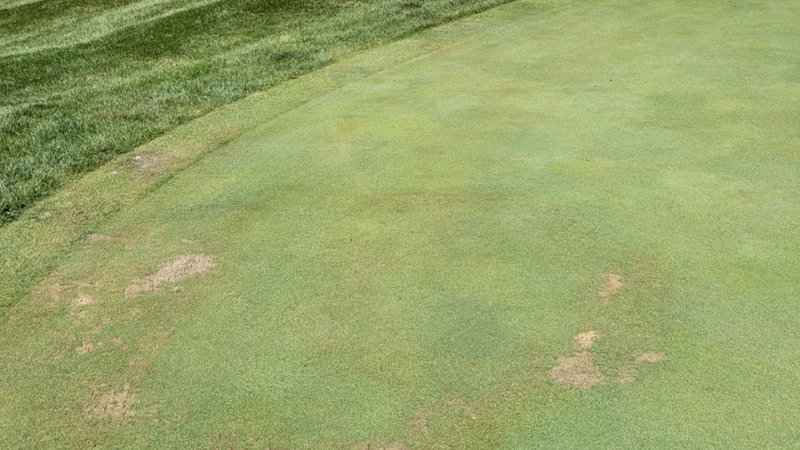
Agronomic practices employed by Lowe to promote recovery included:
- Raising mowing heights and doing so earlier than ever before
- Less aggressive roller to preserve leaf tissue
- Small-core aerification in early July
- Solid tine aerification early August
"While these practices help sustain the turf, they do impact green speed and smoothness," Lowe wrote. "Our priority is not peak performance in August, but optimal conditions as early as possible in September.
If I hadn't gone through '98, I wouldn't have been ready for this year, even with 20-plus years under my belt.
Back in Virginia, Fultz also put into place a program of solid tining and dropping seed, followed by light topdressing every 10 days.
Without that previous experience, like what he endured in 1998, Fultz says he might not have been able to stand up to the pressure of the spring and summer of 2025.
Conditions were so poor in 1998 that he hired a USGA agronomist to conduct a site visit, and told his general manager: "I wanted to make sure it was not my fault, and if it was, I would resign."
"I had a lot of sleepless nights then, because I wasn't sure I would be able to do this," he said of that summer 27 years ago. "But '98 got me through this year. I learned then that slow and steady wins the race. If I hadn't gone through ‘98, I wouldn't have been ready for this year, even with 20-plus years under my belt."