

Like an invading army, a non-native pest from a foreign land is overtaking trees and forests across North America.
Since it arrived in the United States 24 years ago in shipping material, the emerald ash borer has steadily been making its way across the continent, leaving a trail of dead ash trees in its wake. Once a problem restricted to the Midwest, the tiny invasive pest has now been confirmed in 38 states — 13 of which are west of the Mississippi River, including as far west as Oregon. Most recently, EAB was confirmed in Mississippi in 2025. Its presence also has been confirmed in six Canadian provinces
EAB kills ash trees by disrupting the uptake of water and nutrients through the trunk and into the upper reaches of the tree.
The ash borer is native to eastern Asia and was first discovered in the Detroit area in 2002 after it is believed to come to the U.S. in wood packing material aboard a Chinese freighter. It has no natural predators in North America to stop its spread across the continent.
Scientists believe that the pest eventually will reach the entire ash tree range in North America, an area that covers parts of at least 47 of 48 contiguous U.S. states and six Canadian provinces. Each ash borer, however, only flies a few miles throughout its lifecycle.
Its rapid spread has been blamed largely on moving infested firewood. In response, the U.S. Department of Agriculture has limited or prohibited interstate movement of firewood in an effort to restrict or at least slow the movement of EAB.
The website EmeraldAshBorer.info is a comprehensive digital resource managed by researchers at Michigan State University, the U.S. Forest Service and MSU Extension that offers information on how to identify EAB, diagnose damage and control it.
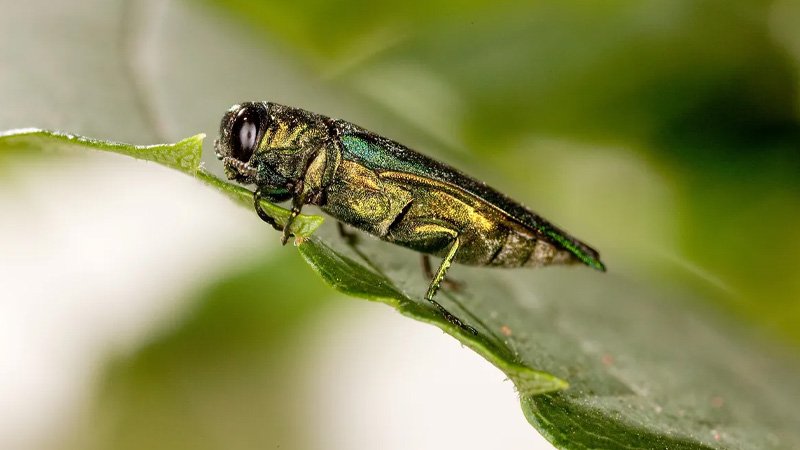
Adult females grow to about a half-inch in length. They chew a hole in the bark into which they deposit their eggs. After hatching, the larvae eat their way through the cambium layer beneath the bark, creating channels that disrupt the tree's ability to move water and nutrients through its vascular system. In the spring, new adults chew through the bark and emerge leaving behind a D-shaped exit hole before flying into the canopy to ingest ash leaves as the reproductive process begins all over again.
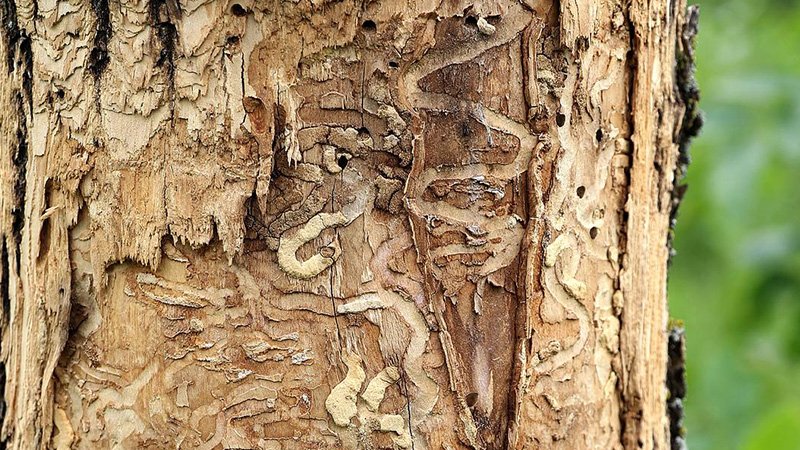
Symptoms of infestation include thinning of the canopy and sprouts growing from holes in the trunk that were created by the pests, along with scores of hungry woodpeckers that eat them. According to the Ohio Department of Agriculture, canopies of mature ash trees typically are decimated within two years of infestation and the trees dead within five years.
Tree canopies can be wiped out within two years, and mature, healthy trees typically are dead within three to four years. All native North American ash species are susceptible to damage.
EAB has been problematic on golf courses with heavy ash tree populations as dead or dying trees become an eyesore, as well as a safety concern.
A guide on the EAB website by MSU researcher Gary Parsons, Ph.D., offers comprehensive information on identifying the pest and distinguishing between other species that might look similar to EAB. According to the guide, adults are a bright, metallic, emerald green. However, the greenish coloration might also include amounts of brassy, coppery or reddish reflections. According to Parsons, that metallic coloration can be influenced by light intensity, direction and quality.