

As the GCSAA marked its centennial anniversary at its conference and trade show in Orlando, the past and future of turfgrass maintenance was on full display at the Orange County Convention Center.
While the history of the profession of turf management was evident with all manner of retro and period equipment, the story of this year's trade show was the overwhelming amount of new technology on display.
There was literally a bright, shiny new toy at almost every intersection on the floor.
There was more autonomous and robotic technology at the show than ever before, and you can bet there will be even more in years to come.
Even companies that historically focus on solutions in a jug are branching out into the world of more touchy-feely technology.
Autonomous and robotic mower manufacturers like FireFly Automatix, Kress and Husqvarna are not strangers to the show, and this year their collective offerings focused more on software upgrades than new hardware.
New on the floor, however, was the Kress Voyager autonomous zero-turn mower that utilizes RTK mapping, LiDAR and Vision AI to navigate complex sites and slopes up to 40 percent.
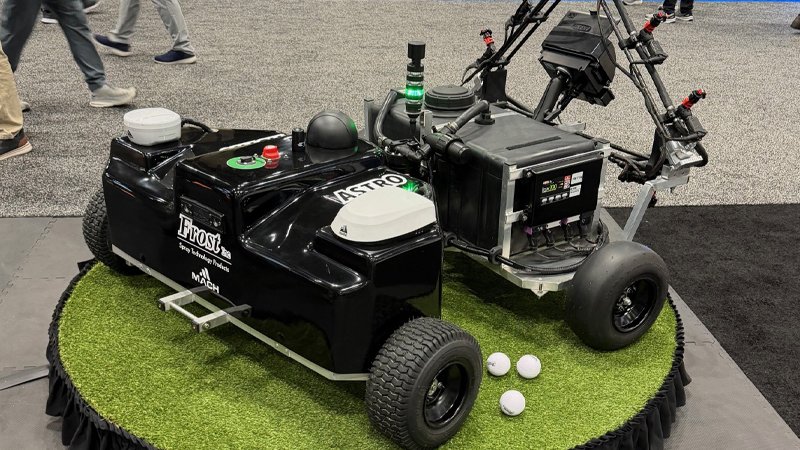
There were other companies, showing off robotic technology, like Frost Inc., with its new Astro autonomous sprayer, the first autonomous sprayer designed specifically for applications on golf course greens. Guided by Ninja GPS, the Astro can cover a wide area with a 19-gallon tank feeding nine nozzles on 10-inch spacing.
Also new were the Pace Technology fleet management system in the Jacobsen booth and the Bright Autonomy platform that promises to turn any piece of mechanized equipment into a robotic machine by retrofitting with just a few parts.
One of the products making the biggest splash in the robotic sector was the new ULM 272 autonomous fairway mower from Baroness, a behemoth of a unit compared with other units in that sector because it can alternate between robotic and human operator control.
The February edition of the Green Section Record hints that the next big thing will be sprayers that use a series of 3D cameras to identify and treat specific weeds.
Even Syngenta, which this year will celebrate the 60th anniversary of Daconil receiving US EPA label registration, was highlighting a new tech tool in its booth with the introduction of the Aero GCX Microclimate Sensor. The Aero GCX can be paired with the company's Spiio GCX wireless soil sensor to become an integrated system that monitors conditions above and below the surface.
For someone who has slogged through 20-plus, mostly boring trade shows, this year's event was the most enjoyable — by far — due to the overwhelming amount of new technology. Ideas that just five years ago were dismissed as unconventional are quickly becoming commonplace and accepted.
As the GCSAA moves into its second centennial, one can only wonder what new technology will be at your disposal in just the next five years, never mind the next 100.