

The accuracy of Syngenta's new Aero GCX microclimate sensor was quickly affirmed Monday when it recalled the overnight low temperature recorded at an Orlando golf course.
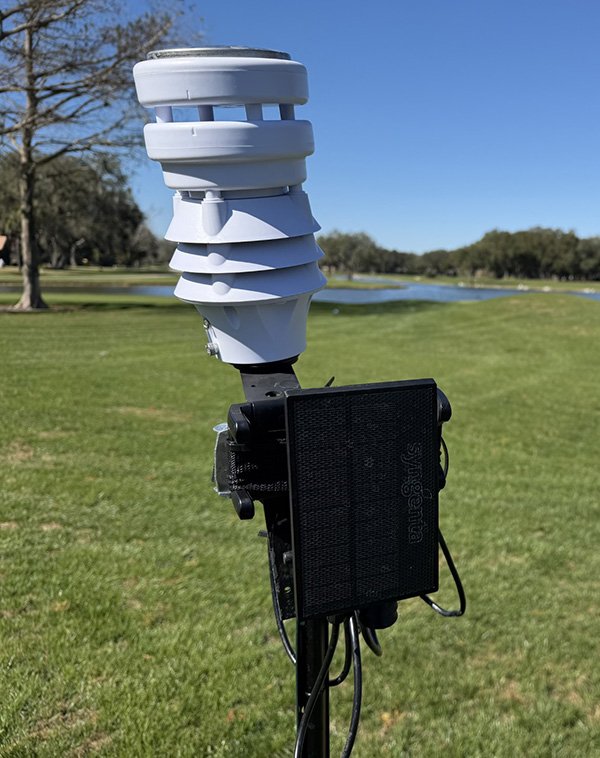 "Twenty-seven," Travis Roberson, Syngenta's digital platforms field technical manager, exclaimed for a group of shivering onlookers at Orange Tree Golf Club, where superintendent and assistant general manager Rob Torri is in his 30th year.
The Aero GCX Microclimate Sensor (right) from Syngenta is one of a handful of innovations that are coming soon from Syngenta, a company known for providing chemical solutions for turf managers, not digital ones.
Until now.
"What's great about digital solutions like Spiio soil sensors and Aero weather stations for micro climate collaboration is that it happens much faster (than chemical solutions), within months, less than a year," said Stephanie Schenke, Syngenta's turf market manager. "We have a whole team who has been trying to bring these digital solutions to the marketplace, and they listen to customers. And they gave us the feedback that weather stations are something they use often, but our soil sensors deliver what is going on on the golf course through Greencast Connect based on their own climate on the golf course. We knew we had something to bring to the marketplace."
The solar-powered sensor collects temperature, humidity and atmospheric pressure in real time that superintendents can access through Syngenta's GreenCast Connect platform, helping them make informed decisions for a host of agronomic practices.
The Aero GCX also can be integrated with Syngenta's Spiio GCX wireless soil sensor to provide turf managers with other key metrics, like soil moisture and temperature.
Recommendations for use, said Roberson, are to install it where it can operate unencumbered at a height of 5 to 6 feet but in a natural grass area representative of what users want to measure.
The system should be available for turf managers by late summer or early fall, according to Roberson. By then, Roberson said, the system could provide real-time information in intervals as regular as 5 or 10 minutes.
Benefits include:
- Comprehensive above-ground environmental monitoring.
- Summaries of trends across the property.
- Real-time data transmission through wireless cellular communication.
- User-friendly cloud-based dashboard accessible through mobile or desktop.
- Easy installation with compact dimensions (5.9 in. x 3.74 in. x 2.3 in.). · Seamless integration with the Spiio™ GCX wireless soil sensor for below-ground insights.
- Ability to monitor microclimates of challenging growing locations across a property.
- Disease forecasting where ambient temperature and humidity are factors affecting establishment.
- Frost forecasting based on indicator locations.
- Increased precision in tracking evapotranspiration.
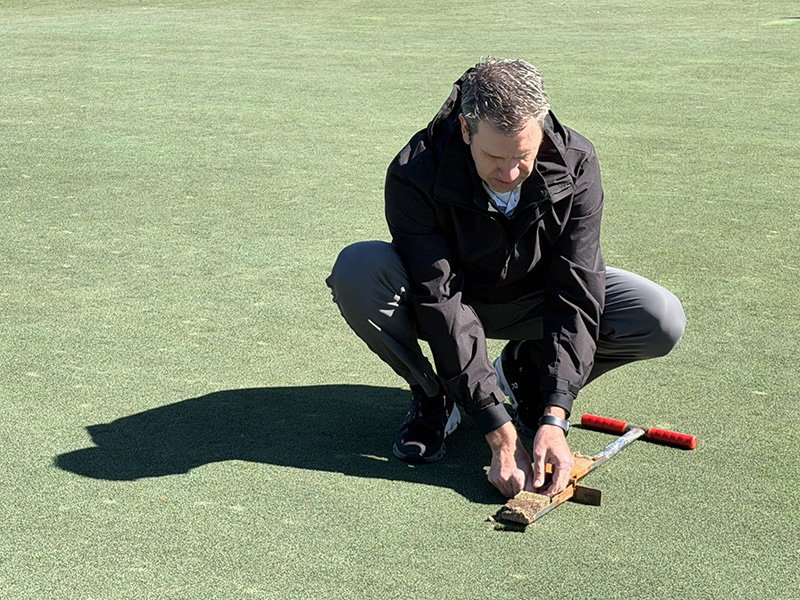
Other innovations unveiled this week by Syngenta at the GCSAA show are Atexzo insecticide and Trefinti, a combination nematicide and fungicide product.
With the active ingredient isocycloseram, Atexzo is a new class of chemistry that received label registration from the U.S. Environmental Protection Agency late last year for control of a variety of common pests in cool- and warm-season turf.
With no signal word or caution on the label, Atexzo is registered for control of annual bluegrass weevil, armyworm, Asiatic garden beetle, Bermudagrass mites, billbugs, black turfgrass ataenius, crane fly, cutworms, European chafer, European crane fly, flea beetle, green June beetle, grubs, Japanese beetle, June beetle, May beetle, mole cricket, northern masked chafers, Oriental beetle, sod webworm, southern masked chafer, sugarcane grub, turf caterpillar and white grubs.
Research has shown it to be especially effective on crane flies, various billbug species, mole crickets in the nymph and adult stages as well as annual bluegrass weevil, an increasingly troublesome pest for superintendents in the Northeast, Mid-Atlantic and Midwest.
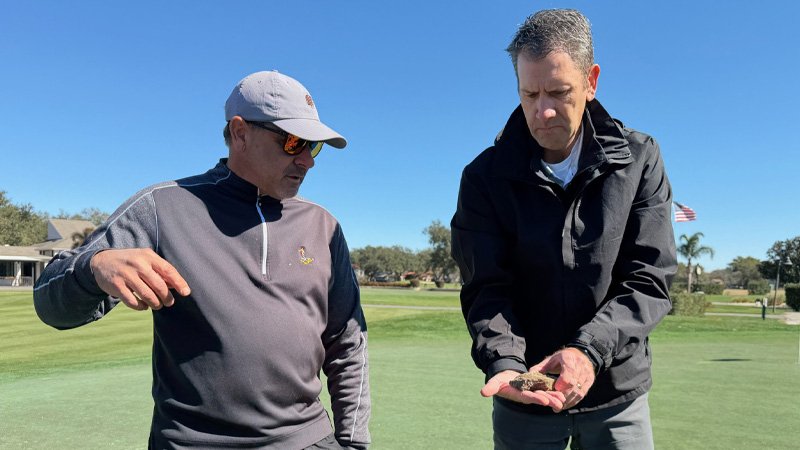
ABW, depending on location, can produce two or three generations per year, and they can be asynchronous with significant overlap among generations, according to Lisa Beirn, Ph.D., Syngenta technical services representative.
Beirn said it is critical to target overwintering generations that emerge in spring to lay their eggs.
With the active ingredient cyclobutrifluram, Trefinti powered by Tymirium Technology, is a nematicide, fungicide product in the phenethyl pyridineamide chemical class. It is registered for control of sting, lance, root-knot, ring, spiral, dagger and sheath nematodes, as well as Anguina pacificae, which is prevalent on the West Coast.
It also is a tool for battling fungal diseases such as fusarium, powdery mildew, spring dead spot, mini-ring, take-all root rot and fairy ring.
Syngenta technical services representative Matt Giese says application timing for control of both nematodes and many fungal diseases, such as fairy ring, often align, meaning optimal control with minimal applications.
Said Orange Tree's Torri: "It's been a game-changer for us."