

A unique turf management educational program that targets non-traditional students entering its fourth year of producing the next generation of turf managers highlights the ongoing need for highly trained professionals in the business of golf course management.
The USGA recently announced the next class in the fourth edition of its Greenkeeper Apprenticeship Program.
"Simply put there still is a need (for more education)," said Carson Nesbella, Ph.D., program director for the USGA apprenticeship program and an instructor at Sandhills Community College in Pinehurst, North Carolina.
"I think that if you talk to anybody that you might run into at a trade show or at one of our association meetings, they still have a need for entry level crew members. While we've addressed some gaps and some holes, at the leadership level, there's still a need to bring in individuals and to train them up and bring them up to speed."
All of our students started the exact same time at the beginning of the year. They stayed together like a family throughout the year and then they graduated at the end of the year together. And so that cohort model means that we have to be a little bit more intentional about how many students we take.
Developed in 2023 by leaders at Pinehurst Resort and the USGA in cooperation with Sandhills Community College, the program provides a mix of classroom instruction with on-the-job training, and pairs each student with an on-course mentor, intended to advance their professional development.
The program was expanded in 2024 to include instruction in cooperation with Horry-Georgetown Technical College in Myrtle Beach, South Carolina. The program provides tuition-free learning for all students for one year and paid on-the-job training positions at partner golf courses.
The Greenkeeper Apprenticeship program is designed to provide:
- A strong foundation in turfgrass and soils science, fertility, pest and water management, rules of golf and leadership skills
- Practical in-class instruction
- Work as an apprentice at a local golf course under the mentorship of a leader in the field to gain valuable experience and connections, all while earning an income as a full-time employee
Through this program, students develop their skills at top-tier facilities such as Pinehurst Resort and Country Club, Tobacco Road Golf Club, The Dunes Golf and Beach Club, Bulls Bay Golf Club and Southern Pines Golf Club.
The program has produced 68 graduates through its first three years.
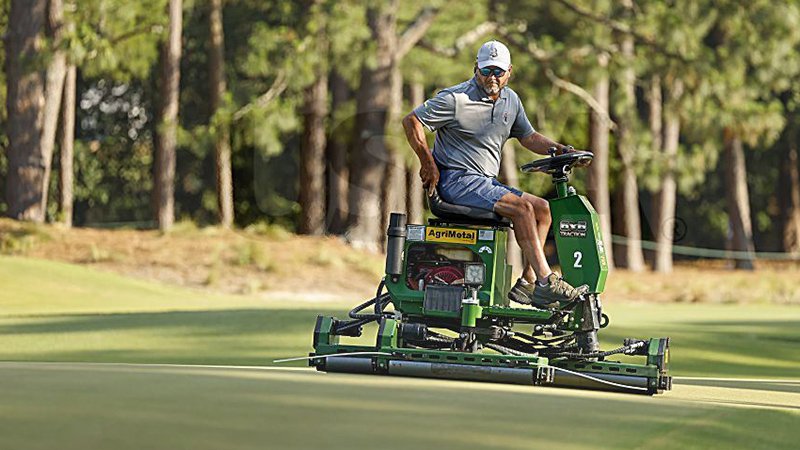
"Those are modest numbers compared to some of the more established programs," Nesbella said. "But at the same time, we're living in a space where with this program, you bring in a cohort. So we don't just take students asynchronously that are going to come in and start their program at one point and leave it another.
"All of our students started the exact same time at the beginning of the year. They stayed together like a family throughout the year and then they graduated at the end of the year together. And so that cohort model means that we have to be a little bit more intentional about how many students we take."
This year's class includes 36 students from 15 states. Among them are:
- Rick Shannon, 53, from North Carolina, who is an active military member with a bachelor's degree in criminal justice and a master's degree in business administration.
- Haley Fox, a Colorado native with degrees in biology and exercise science, the daughter of a PGA professional and a golf course superintendent of more than 30 years.
- Nicholas Chace, who was born in Russia and moved from Massachusetts to join the program.
A role in turfgrass instruction is a natural fit for Nesbella. With two bachelor's degrees from Michigan State (crop science and environmental science), a master's in applied horticulture from Cornell and a doctorate from Penn State in agricultural and extension education services, Nesbella is a natural educator. He served as a graduate teaching assistant while at Cornell and worked as an educator for three years in the public school system in Montague, Michigan, where the classes he taught included AP Environmental Science, Earth Ecology, Natural Resources, Food Science, Vet Science and Integrated Projects in Agriscience.
"I have roughly seven years experience in the industry working on golf courses and athletic fields that I was able to accrue during during my time after high school and through college when I was focused on a crop and soil science degree and a concentration on turfgrass science and that gave me a really nice foundational knowledge for applied turfgrass science management," Nesbella said. "And then from there flipping over into the education space and getting a teaching degree and teaching high school agriculture, and then ultimately getting a doctorate in agricultural education, gave me sort of this sandwich effect, with the content knowledge on turfgrass and then the best practices and high impact educational philosophy.
Simply put there still is a need (for more education). . . . I think that if you talk to anybody that you might run into at a trade show or at one of our association meetings, they still have a need for entry level crew members. While we've addressed some gaps and some holes, at the leadership level, there's still a need to bring in individuals and to train them up and bring them up to speed.
"And so putting those two together, I think it makes for at least myself an individual that can design and deliver a curriculum that is best suited and tailored to the needs of an individual who is in a continuing education capacity and wants to be a developed member of the workforce."
Future plans for the apprenticeship program include not only growing throughout the Carolinas, but other parts of the country as well.
"We envision expanding the program to a couple new sites and identifying those sites this year and locking in those sites to have a 2027 start date," Nesbella said.
"And we think that what's needed about the program is it's going to have some regional influence in the curriculum, and going to have to shift and mold to the needs of those specific climates and the specific stakeholders right within those areas. And so, we've identified a few other sites that we'd like to expand to. And so in the next five-year window, you're probably going to see a map that has a nice little spread across the country of programs that are put in places where there's a high concentration of golf courses, some stakeholders that are extremely invested and supportive of the program in that area, and then also tailored to the needs of the area."
Applications for the 2027 cohort will be accepted later this year.