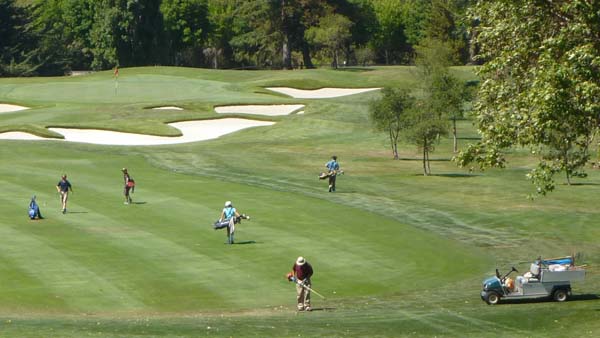

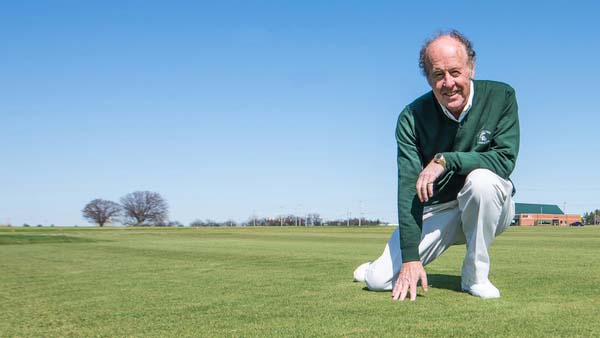
A team of researchers at Michigan State University recently released Flagstick creeping bentgrass, a new cultivar that has exhibited resistance to dollar spot in long-term field trials conducted at the university's Hancock Turfgrass Research Center and at other locations across the country. MSU plant, soil and microbial sciences professor Joe Vargas, Ph.D., the lead researcher in developing Flagstick, said the new cultivar provides a tool to control dollar spot, lower disease management costs and reduce the environmental impact of fungicides. "Most of the fungicide applications throughout the season in the Northeast and Midwest are for control of dollar spot. Last year in Michigan, if it was not for dollar spot, very few fungicide applications would have been applied to golf courses," Vargas said. "Golf courses usually spend about 40 to 50 percent of their fungicide budgets on controlling dollar spot. It's a disease that can't be tolerated because, if you let it go, it will spread and eventually destroy your turf." Dollar spot is a foliar disease named for the silver-dollar-shaped patches of dead grass and silvery film left in its path. Caused by a fungal pathogen, the disease is a top concern for golf course managers in northern areas who rely on creeping bentgrass and annual bluegrass for putting greens and fairways. According to the American Phytopathological Society, more money is spent worldwide on the chemical control of dollar spot than on any other turfgrass disease. Cultivar development began about 20 years ago when Ron Detweiler, a technician in Vargas's lab, noticed patches of grass devoid of dollar spot at the MSU Hancock Turfgrass Research Center. Using grants from the Michigan Turfgrass Foundation and Project GREEEN (a community of like-minded people who promote environmental stewardship), Vargas and his colleagues sampled the grasses and established small plots at the research center. In 2003, Vargas and his team partnered with Seed Research of Oregon, a division of Pickseed USA, to continue testing the cultivar through the National Turfgrass Evaluation Program at various universities around the country, where Flagstick underwent 12 years of testing. "Most of the best discoveries are made through observation," Vargas said. "The best place to look for disease resistance is in the middle of a big outbreak. Developing a dollar-spot-resistant cultivar has been a major research focus at a number of universities for the past 20 years. The fact that we at MSU were able to come up with it is very fulfilling." Flagstick thrives in a wide variety of soils and can be mowed at putting green height. Pickseed USA has produced 4,000 pounds of Flagstick for the 2015 season, with larger quantities expected to be available for distribution in 2016. The work of Vargas and his team is funded in part by MSU AgBioResearch.
- Read more...
- 3,597 views