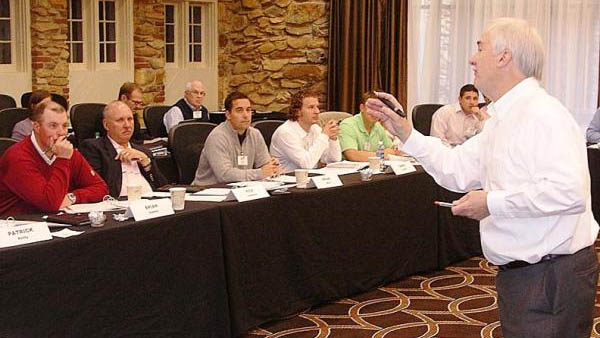
When Jim Pavonetti, CGCS, applied for a spot in the 2015 Syngenta Business Institute, he did so not to learn more about agronomy, but to develop and polish his management and business skills.
"The reason I came is because this deals with things that are outside of our wheelhouse," said Pavonetti of Fairview Country Club in Greenwich, Connecticut. "Making greens great is what we do, but managing boards and owners, those are the kinds of things we can improve upon."
Golf course superintendents seeking to enhance their business acumen can now apply for the 2017 Syngenta Business Institute, an intensive four-day program designed to grow the professional knowledge of golf course superintendents and assist them with managing their courses. Through a partnership with the Wake Forest University School of Business, the program provides graduate school-level instruction in financial management, human resource management, negotiating, managing across generations and cultural divides, impact hiring and other leadership- and professional-development skills.
"We're negotiating every day," Pavonetti said, "whether it's buying chemicals or fertilizers, or working with the finance committee over next year's budget, or selling projects to committees."
The ninth annual SBI is scheduled for Dec. 4-7, in Winston-Salem, North Carolina. Syngenta receives nearly 100 applications annually, but only about 25 superintendents are chosen to attend the program.
"I have attended many conferences and educational sessions in my career, but the Syngenta Business Institute is one of the most unique and rewarding experiences I have ever been part of," said 2015 SBI attendee John Cunningham, CGCS at Bellerive Country Club in St. Louis. "Golf course superintendents are truly responsible for running a business. Having the opportunity to attend three days of business classes focused on the many challenges we face as superintendents was unbelievable. Spending time with other superintendents was beneficial and walking away with best management practices, tools and solutions to help some of these problems was awesome."
To apply, visit GreenCastOnline.com/SBI. Application deadline is Aug. 15, and those selected to attend will be notified in October.
This has been anything but a typical winter for Brian Conlon.
An assistant for the past three years at Miacomet Golf Club on Nantucket Island, Conlon usually spends the winter months keeping busy with offseason projects.
That was then; this is now.
This winter, Conlon, 25, has kept busy helping manage the golf course at one of Mexico's most posh resorts that is a retreat for wealthy business people and Hollywood celebrities.
"There are some locals who play every weekend, so we had to keep the course playable. But we spent a lot of time on projects like brush-cutting and controlled burns," Conlon said. "It wasn't anything I needed to be there for."
If he was going to become a better manager and agronomist and eventually a head superintendent, Conlon figured there had to be a better way to spend the winter. That's when superintendent Ryan Scotto reached out to a friend and former colleague working in Mexico to see if he needed help during the busy winter season.
"Nantucket is a summer destination, so a lot of people work here in summer and leave in winter. Golf pros do it so why couldn't assistants?" Scotto said. "He brought up the idea of going somewhere warm but still working on a golf course. I thought it was a great idea and wanted him to go somewhere he would keep learning through the winter."
Since December, Conlon has been working as an assistant at El Dorado Golf and Beach Club in San Jose del Cabo working under Mitch Peterson. Scotto and Peterson worked together at the Valley Club of Montecito, in California, where they learned at the knee of Roger Robarge.
Today, Conlon is a little more than halfway through a four-month gig at El Dorado, where he is learning to push Bermudagrass greens more than he ever thought possible. Originally, Conlon was going to return to the U.S. in mid-March to start a new job as an assistant at Burning Tree Country Club in Greenwich, Connecticut, but Peterson convinced him to stay through El Dorado's biggest event of the year - Pins & Fins in late April.
It is a career-development route that Conlon recommends to other assistants aspiring to become a head superintendent.
"Don't be afraid to reach out to a superintendent looking for good help," Conlon said. "It's worth looking worth looking into for you and the superintendent.
"I'm down here gaining more experience and learning how another superintendent does things, and I'm also building up my professional network of superintendents."
Conlon paid his own way to Mexico and officially is an employee of El Dorado while he is working there.
It was important to Scotto to promote his assistant's career development, but to do so in a way that benefited all involved.
"There was also a level of trust involved," Scotto said. "I wouldn't have recommended someone to Mitch that I didn't support and wouldn't have sent Brian somewhere he wouldn't have learned from. Mitch and I have similar management styles, so I knew he would be a good fit."
Maintenance standards at El Dorado are off the chart, with daily green speeds around 13, or higher if there is an event coming up.
"The majority of clients at private and public courses in Mexican tourist destinations are Americans or Canadians," Peterson said. "These tourists are looking for equivalent of higher conditioning from their courses from home."
Conlon wasn't sure what that "higher conditioning" meant when he arrived in Mexico, but he knows now.
"The greens haven't been under 12.5 since I've been here," Conlon said. "For the first tournament, they were too fast to Stimp. We couldn't get them to stay on the ridge. If you rolled one way, there was not enough room to go down and back. They had to be about a 15.
"This is a high-end course where everything has to be perfect every day, because you never know who is going to be playing here,"
Conlon believes working non-stop throughout the year at a second property with intense expectations is helping him prepare not only for his next job at Burning Tree, but beyond in his quest to one day be a head superintendent.
I think I can honestly say this is the most valuable thing I've done in my career so far."
"When you have the ability to manipulate greens, you can do anything on a golf course," he said.
"I think I can honestly say this is the most valuable thing I've done in my career so far."
Peterson believes in today's tight job market that others could benefit from the same career choice that Conlon has made.
"Brian taking the opportunity to come down here shows that he's really focused on developing as much as he can and is hungry to succeed," Peterson said.
"Instead of sitting in the Northeast all winter not working he chose to come down here to grow and keep working. He has had the opportunity to see a different course and will pick up tons of useful tricks and tips. Some things are local to this course, but some things he will carry with him for the rest of his career. Brain has seen how we can produce incredible playing conditions in a different environment than he is used to. This will set him apart from the average Joe back home. You can't name one thing that would be a negative from the opportunity he pursued."
After nearly two decades managing the greens at Oakmont Country Club, John Zimmers was named superintendent at the Inverness Club in Toledo, Ohio.
Zimmers, the 2007 TurfNet Superintendent of the Year award winner, takes over for his former protege Chad Mark, CGCS. Mark, who won the TurfNet award in 2013 while at The Kirtland Country Club near Cleveland. Mark took over at Inverness last year, and recently accepted the job at Muirfield Village Golf Club in Dublin, Ohio after Paul B. Latshaw, CGCS, moved on to Merion Golf Club near Philadelphia to fill the void left after Matt Shaffer's retirement.
Whew!
He will begin his new position June 3.
At Oakmont, Zimmers, 45, oversaw course conditioning for the U.S. Open in 2007 and 2016, the U.S. Women's Open in 2010 and the 2003 U.S. Amateur.
Inverness has been the site of four U.S. Open Championships (1920, '31, '57, '79), a pair of PGA Championships (1986, '93), two U.S. Senior Open Championships (2003, '11) and the 1973 U.S. Amateur.
Next up for Inverness and Zimmers will the be the 2019 U.S. Junior Amateur and the Solheim Cup in 2021.
Every year, the first major of the golf season is greeted by birds chirping (real or not), and seas of pink and white azaleas that make The Masters Tournament more event than golf tournament.
Indeed, when Augusta National talks, the golf world listens. But there are some things that even Augusta cannot control, like Mother Nature.
According to published reports, unseasonably warm temperatures this winter have catapulted the clubs famed azalea bushes into full bloom more than a month before this years championship that is scheduled for April 3-9.
It was first reported in late February that the azaleas were in bloom early and that those expecting Augustas typical spectrum of pinks, whites and reds probably would be in for a drab color palette come April. Azaleas, according to the Azalea Society of America, typically bloom for about two weeks.
With temperatures soaring this winter and expected to remain above average off and on over the next few weeks, it does not appear much is going to happen to put the azalea bloom into a stall.
The average daily high in Augusta was 71 degrees in February, which is 11 degrees above the historic average, and average temperatures in January were almost 9 degrees above normal, according to the National Weather Service.
This year would not be the first time the tournament was played without its signature azaleas. Many already had bloomed and wilted on parts of the course prior to the 2012 tournament.
Playbooks for Golf just made it easier for superintendents to communicate with golfers about hole-by-hole course conditions - without ever talking face to face.
Known as Conditions, this easy-to-use software platform helps superintendents communicate in real time to golfers through via a mobile app downloaded to their smartphone. Superintendents can provide updates on specific conditions throughout the property and point out highlights of the course that are communicated to golfers through a push-notification system. Conditions also allows superintendents to declare specific areas of the course off limits through geo-fencing capabilities.
"The reason we developed this simple and very-easy-to-use platform is because we have seen over and over again a lack of communication between golfers and the maintenance of the golf course," said Playbooks for Golf co-owner Greg Wojick. "First came postings in the locker room, then email blasts which transformed into blogs and twitter feeds. The problem with all of them is that they require the golfer to visit them on their own. In particular, maintenance blogs and Twitter have become more of a sharing environment between turf professionals, and golfers get left behind or not engaged. With Conditions, we take the critical course information straight to golfers' phones where they can easily see the entire operation, even hole by hole, in a great app format."
Once installed, the mobile app even can send notifications to specific user groups such as a green committee.
The superintendent is provided with a custom-built and easy-to-use content-management system where they can update anything about the course status at any time and is as easy as writing a text or tweet and guarantees the vast majority of golfers are in-the-know about the course as they play.
"People are now used to receiving multiple notifications or alerts on their phone daily and even hourly," said Playbooks for Golf other co-owner, Matt Leverich. "Instead of hoping you are reaching the target audience, you can be certain with Conditions."
Playbooks takes care of everything on the setup, including submitting to the app stores and populating the app with the course's custom content.
Who knows whether it was fate, luck or divine intervention that brought Chenchen Gu and Steve Agin together at The Club at Ruby Hill in Pleasanton, California? What is important is that each recognized a golden opportunity when they saw it.
A native of Yibin City in China's Sichuan province, Chenchen, or Gail as she's known by her American friends, has been Agin's second assistant at Ruby Hill since graduating from Ohio State with a master's in turfgrass management last May. During her time at Ruby Hill, she also has become an extended addition to Agin's family. The superintendent at Ruby Hill for the past 16 years, Agin spent several years early in his career in Asia. His wife, Sylvia, is from China, and the couple's knowledge of eastern culture has helped 24-year-old Gail acclimate to life in America outside the academic bubble.
"(America) still is a new environment, and it's better to have friends here," said Gail, 24, who speaks English like a native. "If I have problems, I know I can talk to Steve. He understands the Chinese culture."
The two first met at the 2015 Golf Industry Show in San Antonio when Gail was helping translate for another Chinese national who Agin was interviewing for an assistant's position. That candidate didn't get the job, but Agin and Gail stayed in touch when he returned to California and she went back to Columbus, Ohio.
It was her professional drive and determination that caught Agin's attention.
More than once, Gail expressed to colleagues, instructors and professors her goal to be the first woman from China to become a head golf course superintendent in the United States. It is a goal that Matt Williams, program coordinator at the Ohio Turfgrass Foundation Research and Education Center at Ohio State, believes is within reach.
"I know that she misses her family, but realizes that the opportunity to achieve this professional goal is here in the United States," Williams said.
"She was involved in all aspects of our operation, from mowing, fertilizer and pesticide applications, to irrigation repair and equipment maintenance. She has a very scientific and analytical mind. She would look at every situation as a problem that had a solution, and that it was her job to solve that problem. It didn't matter if it was fertilizer calculation or properly installing parking blocks at the facility."
As a student at China's Sichuan Agricultural University, Gail came to the United States in 2012 as part of the Michigan State China Program, and earned a bachelor's degree in East Lansing two years later. Graduate school was a natural path for Gail, whose parents both are college administrators in China.
"I think it's more about Chinese culture than anything," she said. "There you are always told that a higher degree means more opportunities after you graduate. My parents were always very supportive of me going to graduate school."
By all accounts, Gail was a shining star at Ohio State.
"Her whole focus and what she liked to talk about was golf course management," said OSU professor Karl Danneberger, Ph.D. "I think she really loves the profession."
As Gail's time there was winding down, naturally she began to think about "what's next?"
Like so many other superintendents, Agin has struggled to find enough help, so he thought he'd try something different. He recalled Gail was nearing graduation, so he offered her a job at Ruby Hill, the Arcis Golf property about 30 miles east of Oakland where he has been superintendent for the past 16 years.
"I spent 10 years overseas, and in that time I developed an affinity for Asian culture. If I didn't have that experience, our paths probably never would have crossed," Agin said. "I was impressed by her enthusiasm for the industry. I was drawn to that. That is what we try to foster, that spark. I saw that in her."
During an in-person interview in California, Agin pulled out all the stops in trying to convince Gail to leave Ohio in the rearview mirror.
"I told her there is better Chinese food here than there is in Columbus," he said. "When she came out here for a visit, we swung by a Chinese grocery store. I think that sealed the deal."
"I told her there is better Chinese food here than there is in Columbus," he said. "When she came out here for a visit, we swung by a Chinese grocery store. I think that sealed the deal."
All kidding aside, hiring a female assistant - let alone one from the other side of the planet - is not something Agin took lightly.
When Gail moved from Ohio to the West Coast, her parents came from China to make the cross-country trip with her - by car.
"I don't know if it was translated perfectly for them, but I assured them that I would keep an eye on her," Agin said. "She is their only child. "I promised them that I would keep an eye on her.
"When you meet parents of someone in your charge, you want to reassure them that everything is going to be and that we will take care of her."
Obviously close to her parents, Gail talks with her parents by phone just about every day and visits China for several weeks each year. And when she goes Agin holds his breath until she returns, hoping that the pull to move home does not win out over her goal to revolutionize the golf turf management world.
After all, Gail isn't just an employee. She's now part of Agin's family.
"It's been a journey, striking a relationship and finding some commonality," Agin said. "I was an ex-pat in China, she is an ex-pat here. To me this is a little deeper than just hiring a college graduate from out of state."
When the big clubs come calling, usually it is pretty easy to fill an open superintendent's position. More often than not, search committees enjoy an embarrassment of riches as they are inundated with applicants.
Not every golf facility has it so easy.
When Tom Hsieh needed a new superintendent at Gleneagles Golf Club, he didn't have the luxury of sifting through hundreds of resumes. He had two, and neither had any experience as a superintendent, an assistant or even as an intern.
"We are as basic as it gets," said Hsieh, whose company, Gleneagles Golf Partners, has the management contract on the property. "We don't have the support systems and career pathways and long-term traditional growth some clubs offer. But we do offer an opportunity for explosive growth for someone who wants to take a chance and who wants to do everything at a golf course that is beloved in this region.
"I need a guy who wants to work hard, learn and not leave this golf course any time soon."
His new superintendent, Joshuwa Otto, hails from San Jose Country Club, where he was a groundskeeper on Pete Bachman's crew.
"He wasn't the assistant or an intern, and I knew that I wasn't going to get that with what I had to offer," Hsieh said. "I am the bottom rung, the first rung on the ladder, and we are feeling the pressure of the job market."
A city-owned nine-hole layout on San Francisco's scruffy southeast side, Gleneagles is the pre-ball version of Cinderella. A 1962 Jack Fleming design, she toils, forgotten, with a mop and bucket, while her spoiled stepsisters Sharp Park and TPC Harding Park wile away the hours preparing for their inevitable meeting with destiny.
While the city and the Tour dote over Sharp and Harding, Gleneagles fights tooth and nail for scraps. A recent accord with a labor union that provides low-cost help on the golf course while providing at-risk workers a valuable trade, has helped lead a revival at Gleneagles, which Hsieh believes is on its way to becoming the belle of the ball for a surrounding community in need of hope.
He has workers and the backing of several community leaders and agencies who recognize both the need to maintain a civic gem that is Gleneagles, while at the same time using it as a training ground to improve the lives of some of the city's forgotten residents.
Otto is taking over for former superintendent Gabriel Castilla, who left after seven years for a position as foreman at The Presidio.
Eventually, the goal is for Otto to run everything, from the golf course to the golf shop and bar, and everything in between. But for now, he's learning to run the golf course. The job of tending bar, collecting green fees and even mowing fairways and roughs has fallen on the shoulders of Gleneagles' starters/bartenders (who are one in the same).
In the long term, we want the property to be more than a golf course. It has to be a community resource, an academy to help the under-employed and under-served communities."
The idea of combining tasks, and thus offering more hours (and more money) to the same group, Hsieh said, was the idea of Thomas Bastis, CGCS. Superintendent at The California Golf Club of San Francisco, Bastis is not only Hsieh's friend, but also has been his agronomic mentor and consultant for most of the past decade.
"They go from pouring a manhattan, to taking green fees and get you on your way, to cutting cups and mowing fairways before their shift starts," Hsieh said.
"They love the course, and they are who I want here on this land because they are trying to make this experience the best it can be for our customers."
Three years ago, Hsieh realized he had to do something different if he was going to keep Gleneagles open. The course, which has to be self sufficient since it is not funded by the city, had entered into a death spiral of declining play, revenue and conditions.
Without golfers coming in the door, there was no money to invest in the golf course. Without investments in improved playing conditions, golfers weren't coming back. It was a scene that has been played out on hundreds of courses nationwide in the past decade.
That's when Hsieh and a local trade union reached an agreement to provide laborers for the golf course from the city's at risk community. Gleneagles receives low-cost help in six-week blocks a few times a year, and those workers receive union-backed apprenticeship training and a support network that helps them on the road to full-time employment when they "graduate" from Gleneagles.
It's a win-win-win situation for Hsieh, who receives the help he needs, workers who have hope where before there was none and the community that has its golf course back.
"In the long term, we want the property to be more than a golf course," he said. "It has to be a community resource, an academy to help the under-employed and under-served communities."
The community wants Gleneagles to survive. Hsieh already offers FootGolf on the property and recently, he fielded inquiries about carving a disc golf course out of the property. Hsieh had his doubts. He told the disc golf crowd, which typically plays for free in public parks, that they'd have to pay a fee at Gleneagles to help offset the cost of labor at this revenue-starved facility.
Hsieh established an Indiego.com crowd-funding account anyway to gauge whether there was any real interest. He set a goal of $10,000 to help cover the cost of buying baskets and other equipment and clearing land for the routing. To his surprise, that goal was reached in three hours.
"These are the kinds of things small golf courses that don't have big bucks have to do to get creative and survive," he said.
"We will have it bookended: We'll have the least expensive round of golf and the most expensive disc golf round in San Francisco."
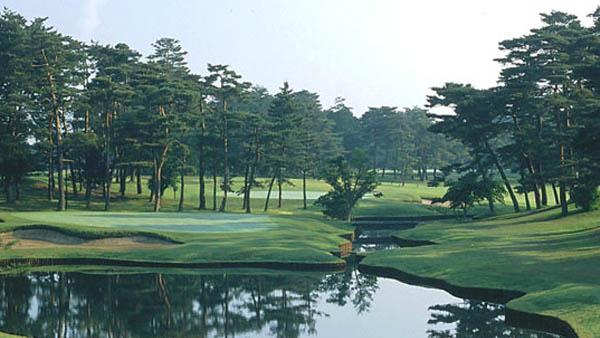
When the 2020 Summer OIympics go to Tokyo, at least officials there won't have to create a new golf course for the event. That doesn't mean there aren't challenges to address between now and then.
Kasumigaseki Country Club traditionally has been a men's only club, but that practice appears to be changing, according to the International Olympic Committee. In January, club officials announced that there were no plans to change their membership policy of excluding women from having full golf privileges.
That potential shift in policy is in response to a directive from the IOC chief telling the club to become more accepting of women, or else the games' governing body will find somewhere else to play in three years.
"Our principles are based on non-discrimination, that's the position we've made quite clear," said IOC vice president John Coates in several published reports.
"There has been progress - as recently as this week there have been more discussions with the club (to suggest) it's heading in the right direction for them to have a non-discriminatory membership procedure."
Built in 1929, Kasumigaseki Country Club underwent a 2014 restoration by Tom Fazio.
The choice of a men's only facility for an event that will include competition for the worlds best women players seems curious at best, and the club and the IOC have come under fire from several fronts in the past six weeks. At least one group inside Japan dedicated to advancing women's rights issues already has demanded the competition be moved, and Lydia Ko, one of the LPGAs brightest young stars also has spoken out about hoping the matter is resolved soon.
The issue wasn't even part of the news cycle until mid-January when Tokyo Gov. Yuriko Koike publicly urged the club to admit women as full members, according to The Associated Press.
Coates told reporters he hoped the situation would be resolved by this summer, otherwise the IOC will be forced to find a new venue. The IOC does not have a hard deadline for the club to change its policy, but hopes the matter can be resolved by this summer.
There's a saying that "you don't know what you don't know."
Loosely translated, it means that it is near impossible to understand the depth of a topic without a basic grasp of the facts. Never has that been more true than with the study of weather, or climatology or whatever label one cares to apply.
There was a TV weatherman in Cincinnati in the 1960s and '70s who almost made a joke of how often forecasts, including his own, were incorrect. Those self-deprecating forecasts centered around a small bell hanging on the wall of meteorologist Todd Hunter's set and a number system next to it that was not unlike the one's used to hold a place in line at a supermarket deli or the DMV. A sign hanging next to the numbered tags read "gongless days."
Each time Hunter made a correct forecast, a number was pulled counting how many consecutive days he was right. When he missed on the previous day's weather forecast, he'd ring the bell and turn the count back to zero. More times than not, Hunter was haunted by that bell.
More than 40 years later, not much has changed in the way scientists predict the weather. Thus, their ability to run together a string of gongless days hasn't improved much since Todd Hunter struggled with it in the days when The Beatles were still kickin' out vinyl.
The fact that weather is an inexact science should be a warning to golf course superintendents not to take too much for granted, especially in California, says Craig Kessler, director of government affairs for the Southern California Golf Association.
The bottom line, with 140 years of weather data, we have no clue how to predict weather patterns."
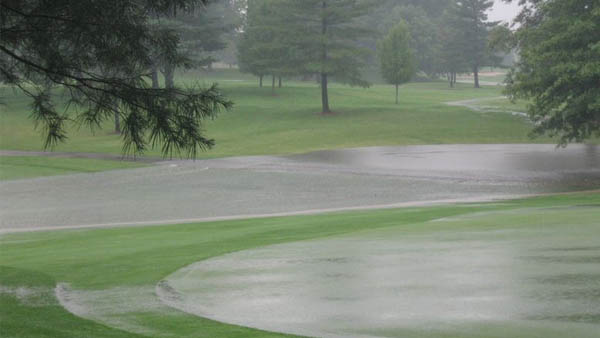
For years, California was mired in what has been called one of the worst droughts in the state's history. Nowadays, the drought seems like a distant memory. Reservoirs around the state are full or nearly full, and most currently are holding much more than the historic average, according to California's Department of Water Resources. One in particular, the dam at Lake Oroville, recently has been in the news for because of a failing spillway that has sent millions of gallons of water down the Feather River and is a reminder of just how wet it is in California.
Weather forecasts this year and last have gotten it mostly wrong regarding the rain in California, meaning meteorologists probably wouldn't have earned many gongless days under the old Todd Hunter model.
"Last winter, they predicted rain with warm Pacific waters in an El Nino pattern, and we had a dry year," Kessler said. "This year, it was supposed to be the opposite. But we've had, in essence, straight-shot warm, tropical water that we were supposed to get under the El Nino, but that we're getting in a La Nina. The bottom line, with 140 years of weather data, we have no clue how to predict weather patterns."
The snowpack in the upper elevations of the Sierra Nevada, which provides much of the state's drinking water through the State Water Project, is at 173 percent of average and has replenished more than one-third of the state's snow-water deficit, according to the information from the California Department of Water Resources. Even Southern California, which derives much of its potable supply from the above-mentioned State Water Project as well the now full Colorado River basin, has been getting rain.
Rainfall totals since October are up by 75 percent in Los Angeles and 60 percent in Palm Springs.
So, what is a golf course superintendent to do? Conduct business as if the drought were still in effect, say two of the state's leading experts on golf course irrigation matters, th
Short term, this is a God send of relief. . . . In the long term, nothing really changes. Golf has a powerful incentive to continue to reduce its water footprint."
Although the drought officially is over for much of the state, efforts to conserve water and find additional ways to cut back are as important as ever, because while impoundments holding surface water are full, underground aquifers are not. Even if California has several more rainy winters, it will take years, if ever, to replenish the state's groundwater supplies.
Californians believing their days of using less water are over, are fooling themselves.
"Short term, this is a God send of relief," Kessler said.
"If we get into a drought again, and we will, water for recreation is one of the first things that goes. We get some consideration over parks, but not much. In the long term, nothing really changes. Golf has a powerful incentive to continue to reduce its water footprint."
Ali Harivandi, Ph.D., tells a similar message. The former University of California extension specialist and arguably the country's leading expert on reclaimed water, Harivandi still tells superintendents they should be managing water as if they are in the throes of drought.
"I caution everyone, especially in golf and turf in general, to continue what they have been doing, because it is confined business, and it cannot survive without good water. (Superintendents) should continue their efforts to reduce water use; continue and actually be more aggressive," Harivandi said. "I've been in this business for close to 40 years, and it's like a broken record: We have five or six years of major drought, and everybody and their cousins become environmentalists. Turf is the first prime material that becomes the villain, and golf is an easy target. Then as soon as the rain comes, everyone forgets about it."
Gary Ingram, CGCS, at Metropolitan Golf Links in Oakland is taking that message to heart.
With a sizeable portion of its irrigation water coming from groundwater aquifers, Metropolitan Golf Links had it better than most during the drought. Still, that didn't stop Ingram from cutting back his water use when he wasn't required to do so.
He turned off water to 20 acres that previously were irrigated, including out-of-play areas and the driving range, simply by shutting off the tap and making modifications to sprinkler heads.
Reducing irrigated acreage has been part of Ingram's turf management philosophy since he became a superintendent in the 1970s.
"We mandated ourselves to do what is right," Ingram said. "We reduced consumption because it was the right thing to do."
I caution everyone, especially in golf and turf in general, to continue what they have been doing, because it is confined business, and it cannot survive without good water."
As president of the California GCSA, Ingram is positioned to make a difference moving forward. It's an opportunity he is not taking lightly. He is working with other superintendents throughout California, university professors and members of the California Alliance for Golf in establishing a state BMP template that colleagues from the Oregon stateline to the Mexico border can use to help save even more water in the future.
With the recent release at the Golf Industry Show of the GCSAA-led BMP template that was completed by scientists at the University of Florida, the California contingent plans to use that national BMP to help draft their own plan.
Water will be just one part of that template, but it will be an important one nonetheless.
"What is important is that we look at the golf industry as part of the community," Ingram said. "And we have to look at water as a commodity that is important to the community. We have to do what's right. That means not only being aware of how much water we use, but where it goes, as well."
Whatever Ingram and the rest of the BMP task force come up with in regards to water use, Harivandi says the goal should be an ambitious one because of the threat of future drought and the state's groundwater crisis. He recommends golf courses further reduce the amount of irrigated land over the next several years, and he's pointing to an ambitious NASA project as proof that just about anything is possible.
"If golf courses want to stay viable, every golf course superintendent, owner and manager should be thinking about how they can reduce the amount of irrigated land by 50 percent by 2025. It's not impossible. If they're talking about putting someone on Mars by 2023, then I think we can do this," Harivandi said.
"It's not reducing water use by 50 percent; it's reducing the amount of land that is watered by 50 percent."
Such a plan would yield much more than just savings in the monthly water bill, says Harivandi.
"They will not only reduce their water footprint, but will also reduce inputs (including) fertilizers, pesticides, mowing, aerating, labor etc," he said. "That means significant reductions in maintenance costs. The price of water is also steadily increasing everywhere."
When it comes to keeping equipment in top operating condition, Pikewood National Golf Club equipment manager Kris Bryan stacks up against anyone, says his superintendent, Brett Bentley. That's saying a lot at Pikewood, where the natural terrain takes a heavy toll on mowers, utility vehicles and just about anything else with an engine and wheels on it.
A top-shelf preventive maintenance program that keeps equipment on the golf course and out of the shop is just one reason Bryan was named last years winner of the TurfNet Technician of the Year Award, presented by Toro.
Located atop a mountain in northern West Virginia, Pikewood National occupies about 200 hilly acres of a 700-acre parcel, creating tremendous wear and tear on mowers and other equipment.
"Kris has a great preventative maintenance program," Bentley said. "He does a very good job keeping equipment running.
"He is a perfectionist, which is what we need."
If you have a technician who is the backbone of your operation and deserves such recognition, nominate him for next years award.
The winner will receive the Golden Wrench Award (a real gold-plated wrench) from TurfNet and a weeklong training session at Toro's Service Training University at the company's headquarters in Bloomington, Minnesota.
Criteria on which nominees are judged include: crisis management; effective budgeting; environmental awareness; helping to further and promote the careers of colleagues and employees; interpersonal communications; inventory management and cost control; overall condition and dependability of rolling stock; shop safety; and work ethic.
In other words, tell us what makes your technician worthy, with specific examples of what he or she has accomplished. The more we know, the better your tech's chances of getting noticed.
CLICK HERE to submit a nomination using our online form. All finalists and the winner will be profiled on TurfNet.
Deadline for nominations is April 30, 2017.
Previous winners are (2016) Kris Bryan, Pikewood National Golf Club, Morgantown, WV; (2015) Robert Smith, Merion Golf Club, Ardmore, PA; (2014) Lee Medeiros, Timber Creek and Sierra Pines Golf Courses, Roseville, CA; (2013) Brian Sjögren, Corral de Tierra Country Club, Corral de Tierra, CA; (2012) Kevin Bauer, Prairie Bluff Golf Club, Crest Hill, IL; (2011) Jim Kilgallon, The Connecticut Golf Club, Easton, CT; (2010) Herb Berg, Oakmont (PA) Country Club; (2009) Doug Johnson, TPC at Las Colinas, Irving, TX; (2007) Jim Stuart, Stone Mountain (GA) Golf Club; (2006) Fred Peck, Fox Hollow and The Homestead, Lakewood, CO; (2005) Jesus Olivas, Heritage Highlands at Dove Mountain, Marana, AZ; (2004) Henry Heinz, Kalamazoo (MI) Country Club; (2003) Eric Kulaas, Marriott Vinoy Renaissance Resort, Sarasota, FL.
There was no award in 2008.
Pictured on front page: 2014 Golden Wrench winner Lee Medeiros (center) with assistant technician Mohammed Nawaz (left) and superintendent Jim Ferrin of Timber Creek and Sierra Pines golf courses in Roseville, California.
Larry Hirsh could have starred as the straight man in one of those old satirical V-8 commercials when he provides his unwitting costar with a bit of clarity in which they experience one of those "aha" moments. You know the kind of moment I'm talking about; the opportunities that are staring you in the face, but you never recognized them until someone else comes along to point them out.
Indeed, Larry has a very different and unique relationship with the game of golf and the rest of the industry.
As a lifelong golfer, his love for the game is obvious to anyone who meets him. He is a current or past member at some of the finest clubs in the country, and he possesses an A-game. He knows and appreciates the history of the game and the contributions of superintendents who make the golf experience what it is. He runs in Brad Klein's circle, and that alone is enough for me.
As the principal of his own company, Golf Property Analysts, Larry also offers an array of consulting services for those looking to buy or sell golf courses, including those that are in financial distress.
To Larry, as well as the rest of us who rely on the game to provide a roof over our heads and something to eat at the end of the day, the struggles facing the golf industry are the ugly side of an otherwise great business.
About a million people a year are finding something else to do with their time, and thus courses have been closing at a brisk clip for a decade now. It's a disturbing trend that shows no sign of slowing anytime soon.
A colleague and long-time veteran of the golf business recently told me "the fun is gone from this business."
That might be overstating things just a bit, but it underscores the fact that at every turn, it's just a lot harder today to make a go of it in golf than it was 15-20 years ago.
Still, we've become largely immune to the doom-and-gloom news every year of how many courses have closed, how many people quit the game, older folks are carrying the game and millennials aren't playing.
Battling through the bad news is the dues we pay to stay in the game. The cost of doing business.
Golf course closures are just business. Cold and impersonal. But every once in awhile, the grim reaper of golf steps forward and claims a property that pulls at the heartstrings. And I have Larry to thank for reminding me that it's not all just business; that there is a personal side to this as well.
Recently, Larry's e-newsletter told the tale of a golf course that soon will close, but it wasn't just any golf course. Blue Ridge Country Club in Harrisburg, Pennsylvania was the course he grew up playing, the course where he taught the game to his children.
Here is a snippet from Larry's newsletter: "The club I grew up at, where I learned the game from my father, taught my sons the game, won and lost club championships, made friends and some foes, went to weddings and bar-mitzvahs and spent many idle hours shooting the breeze in the pro shop, on the patio or in the bar, Blue Ridge Country Club in Harrisburg, PA will be shutting its doors in favor of mixed development at the end of the 2017 season."
Courses will come and go, but there is no replacing memories like that.
The story reminded me of my own personal golf course casualty.
My dad has been gone a long time, 29 years to be exact. I had just picked up the game shortly before he was diagnosed with cancer, so we played together a little bit, but not much. The golf course, however, was where I got to know his fill-in, my father-in-law.
My wife's father was another A-gamer. He's still with us, but his health now prevents him from playing, or doing much of anything else for that matter. To this day, I have a deep bond with him, and it's one that was largely formed on the fairways of Dodger Pines Golf Club in Vero Beach, Florida.
J.L. is as tough as they come. He's survived multiple bouts with cancer and heart problems, and even though he's in his 80s, I'm convinced he could still kick my ass . . . if he could just catch me. That toughness was forged in a hardscrabble life as a child in upstate New York. College football was his ticket to a future. And it's one he didn't waste. He remembered where he came from and knew he didn't want to go back. He became a success in business, raising a family of five kids who never wanted for anything.
That hard road through life made him tough and confident, and those traits made him a great golfer.
Each spring when he left Florida to return home to Ohio, he'd won enough men's club events that he usually went home with half the pro-shop's inventory in the backseat of his car.
Dodger Pines was a great place to forge a relationship and learn about the game's history. The course was located across the street from the Dodgertown baseball complex that once was the spring training home of the L.A. Dodgers. Celebrities of every kind - Hollywood icons, professional athletes from other sports - often could be spotted here, and their photographs still adorn the walls of the quaint restaurant located at the town's tiny airport located within walking distance of Dodgertown, at that time the only place east of Los Angeles where one could buy a Dodger dog.
Even long after he retired from baseball in 1966, former Dodger pitching great Sandy Koufax was a regular at Dodger Pines.
The stories there poured forth from the bar like beer out of the tap, like the tale of the 660-yard third hole that was converted from a par-5 to par-6 only because former Dodgers owner Walter O'Malley never could make par there.
I always knew my father-in-law was tough, a throwback to another era. But it was at Dodger Pines where I learned it best.
There were countless examples, but none more defining than the day when a tee shot on a back nine par-5 went astray. Buried deep in the woods, J.L. had the narrowest of windows through which he could escape. On the other side was the green, about 225 yards away. He looked over his situation and laughed saying "I need a pretty good shot here, don't I?" I watched in amazement as he hit his ball on a line-drive with a 5-wood off a bed of pine needles through a gauntlet of pine trees to within 5 feet of the flag. When he putted out for eagle, I knew I was out of my league . . . on several levels.
Dodger Pines closed in 2002, long before the golf business started on its roller coaster ride to hell. The casualty of a revolving door of Dodger owners, the course was sold for real estate development to some speculator who had designs on turning it into a mixed-use property that would include retail and residential space.
It was a bad idea in a town already starving for quality daily fee golf.
Financing never materialized, then shortly thereafter the economy tanked. There never was any high-end retail, or posh condominiums built there. Before you knew it, Dodger Pines had become a weed field, an eyesore.
Gone were the memories and the history that can never be rewritten. And for what? Nothing. It took that letter from Larry Hirsh to stir this emotion again after years of being jaded by this course closing and that course closing its doors.
Maybe that colleague was right after all. Maybe the fun is gone from this business after all.
For the past two-plus years, life throughout the University of Florida turf research network has been all about BMPs.
Recently, scientists throughout the university's multi-campus matrix completed work on a nationwide BMP guide for golf course superintendents that was launched during the Golf Industry Show.
After more than two years of work to develop a plan that can serve as a template for turf managers anywhere in the country, the logical question is "what's next?"
Since that plan was completed, Bryan Unruh, Ph.D., professor and associate director of the West Florida Research and Education Center in the Panhandle has been drilling down even further to provide a guide that makes pesticide selection easier and less complex.
"When you select a pesticide, what are the things you look at?" Unruh asked rhetorically. "We wanted to develop a protocol for making these choices."
Increased documentation and reporting have made it more important than ever to know what organisms - both target and non-target - are interacting with the golf course, what products are being used and the relationships between them.
So far, the pesticide-selection tool exists in theory, notes and the beginning stages of a PowerPoint presentation, but soon will be in a science-based published form, Unruh promised.
According to the model, there are five areas that must be addressed when selecting a pesticide: efficacy, impact on threatened or protected species, resistance management, impact on human health and impact on the soil.
Efficacy typically is the most important factor influencing pesticide selection. After all, a product isn't much good if it doesn't work. The tool will include data existing BMP data from Florida and other states and will draw from university research conducted from across the country.
Although efficacy is important, environmental responsibility plays a big role, especially in today's world of documenting nearly everything that occurs on a golf course. For example, many superintendents go to a great deal of effort to provide habitat for many types of wildlife species, and it is important to make sure pesticides that are selected are consistent with those efforts. Unruh points to the protected Florida scrub jay, which happens to be listed specifically on the labels of some pesticides.
"Superintendents are doing a great job of record-keeping," Unruh said. "If you document that you have the Florida scrub jay on your property, but you are spreading (product name deleted) wall to wall, you can get your butt in a ringer."
Resistance management becomes increasingly difficult because some products already are out of the mix due to resistance, while others combine as many as four active ingredients in a single solution, making rotation of chemistries all the more challenging.
"And when you have four chemistries, you have four that are not at full strength," Unruh said, "so you're potentially low-dosing, which is not a good idea, either."
Turf managers, Unruh says, become so dependent on the efficacy of a product that little thought is given to how it might affect the soil or what lies beneath it.
The forthcoming pesticide-selection BMP tool will provide a framework for selecting products that take local soils and conditions into account. Among the tools it uses are data from the USDA Soil Survey that is like an X-ray into what lies beneath the surface.
"Part of the whole BMP thing that we're doing is creating a bunch of tools that are there for people to reach in and use," Unruh said.
"If you're in an area with a shallow water table, and it's the rainy season and the water table is elevated, there are probably some products you're going to want to steer clear of."
The Pesticide Selection BMP will be the subject of an upcoming TurfNet University Webinar, so stay tuned for more.
Data-driven decision making was the overarching theme at this year's Golf Industry Show, with several vendors eager to show attendees how they can help them collect information and use it to make more informed choices about golf turf management.
Count Syngenta among the latest group to delve into that field.
During the show, Syngenta launched the GreenCast Turf App that makes calculating sprank tank mixtures easier than ever.
Users simply define the area to be treated, product information, spray tank size and volume and sprayer speed in mph and the Greencast mobile app does the rest, and develops a specific spray program, including how much water to add to the tank.
Available for Apple and Android devices, including smartphones and tablets, the mobile app tracks usage, keeps and maintains records, generates reports and helps users navigate the road toward sustainability.
"We recognize the importance of precise tank-mixing and product rates for optimized application as well as environmental stewardship," said Stephanie Schwenke, turf market manager at Syngenta. "This new app simplifies communication and application planning through accurate tank-mixing calculations. These plans can be easily saved and shared with your applicators in English or Spanish."
Tank-mix plan reports can be shared in multiple file formats including PDF and CSV. They also are saved within the application for easy record keeping. These reports include information required by government agencies, including date and time of applications, driving speed, weather conditions during the applications, nozzle details, active ingredients used, quantity and more.
A Spanish-language version of the app also is available to help reduce the risk of errors or misinterpretation of verbal or written instructions.
To download the app, please visit the Apple App Store or the Google Play Store.
Since 1944, June 6 has been remembered as the day the Allies invaded Europe, signalling the beginning of the end of World War II. This year, that date also will mark a new beginning in women's golf.
Women's Golf Day is a one-day, four-hour experience that will take place at golf courses around the world where women and girls can experience golf for the first time and where current players can play and engage with women interested in golf. And it all will take place at golf courses and retail locations around the world on D-Day.
Founded by Elisa Gaudet, president of the consulting and marketing firm Executive Golf International, WGD is a collaborative effort that includes golf management companies, retailers and organizations all working together to engage, empower and support girls and women through golf. That list includes the NGCOA, European Golf Course Owners Association, World Golf Foundation, International Golf Federation, Billy Casper Golf, ClubCorp, All Square, Expert Golf, Women & Golf and the International Council of Nurses.
The concept, which was rolled out recently at the PGA Merchandise Show, albeit by a panel comprised of men, is built on three pillars of Engage, Empower and Support.
Engage includes introducing women and girls to the game, empowering them for future success by providing them with recreational, social and business skills that last a lifetime, and offering support through a network of dedicated industry partners. The four-hour experience allows a simple and accessible platform to build a foundation and creates a network to support the continuation of the game regardless of skill level through instruction, play and socializing
To date, 485 golf courses and retail outlets in 30 countries across five continents have registered to take part in Women's Golf Day.
Women's Golf Day is an excellent to way to introduce women to the game. The event gives them a comfortable and fun atmosphere to experience golf as a game, but also showcases how it connects people and fosters life-long relationships."
"Women's Golf Day is an excellent to way to introduce women to the game," said Mark Gore, vice president of golf for ClubCorp. "The event gives them a comfortable and fun atmosphere to experience golf as a game, but also showcases how it connects people and fosters life-long relationships."
Women's Golf Day couldn't have come at a more opportune time. Men have been dropping out of golf at a steady pace during the past decade. Women, on the other hand, have, by and large, been drawn to the game and represent a growth opportunity.
That all changed in 2015. There was a net gain of about 400,000 female golfers in 2014. According to the National Golf Foundation, that many females, and then some, left the game in 2015, dropping out out at a rate of 7.5 percent, which was more than double the rate at which men were leaving the game.
Women make up less than 25 percent of the U.S. golfer population, but make 80 percent of the household budget decisions, and thus still represent a growth market. The trick is finding ways to lure them in.
"Women play a critical role in the success of the golf industry," World Golf Foundation CEO Steve Mona said on the WGD web site. "Nearly 23 percent of all golfers in the U.S. are female and the creation of Women's Golf Day is an opportunity to increase awareness, participation, and showcase golf as a fun activity for people of all ages."
No one would blame Dick Gray if, after 51 years as a superintendent, he had become complacent in his job.
Yeah, that's not about to happen.
In fact, it can be argued that only Jack Nicklaus has made a larger impact on the golf industry on Florida's Treasure Coast and Palm Beaches than Dick Gray. And at age 73, he still has an edge that is reminiscent of an athlete with a chip on his shoulder. Seven days a week, he continues to attack his job the same way he targeted opposing "wrasslers" in high school and college back in Indiana in the 1950s and 60s - like he still has something to prove.
"I see the world through the eyes of a guy who has been on the mat," said Gray, superintendent at PGA Golf Club in Port St. Lucie. "When I see someone, I'm sizing him up. I'm looking for opportunities and holes so that if push comes to shove, I know where I'm going and he doesn't. And that's my world."
Gray has spent a lifetime making good courses great, and despite his rough exterior, he has a unique approach to personnel management in an industry known for chewing up and spitting out the personal lives of those who work in it.
For his years of dedication and lasting impact on golf courses from his native Indiana to Florida and a stop or two in between, Gray was named the winner of the 2016 TurfNet Superintendent of the Year Award, presented by Syngenta.
Four years ago, PGA Golf Club wasn't on the precipice of disaster. It already had been pushed over the edge, said general manager Jimmy Terry, who was hired shortly after Gray to revive the association's flagship property.
Fairways showed more weeds than turf and many greens throughout the property were flat dead. Terry said he has a photo depicting conditions before Gray's arrival that shows a green with mostly dead turf save for one square of sod so there was something to cut a cup into.
After four years, the property is back, membership is up by more than 10 percent and Gray is overseeing a multi-phase renovation that will have the property looking and playing like it did when it opened in the early 1990s.
Gray was chosen by a panel of industry judges from a field of six finalists that also included Tom Feller of Cedar Rapids Country Club in Cedar Rapids, Iowa, Michael Golden of Longshore Golf Course in Westport, Connecticut, Brian Green of Lonnie Poole Golf Course at North Carolina State University in Raleigh, Kevin Seibel of Century Country Club in Purchase, New York, and Billy Weeks of Duke University Golf Club in Durham, North Carolina.
That group was selected from a field of 228 total nominees.
Criteria on which nominees are judged include: labor management, maximizing budget limitations, educating and advancing the careers of colleagues and assistants, negotiating with government agencies, preparing for tournaments under unusual circumstances, service to golf clientele, upgrading or renovating the course and dealing with extreme or emergency conditions.
Gray deflected responsibility for his success to his crew back in Port St. Lucie.
"There are 75 guys and gals back at the club who are the ball bearings that make everything run," he said. "I'm just the grease gun that keeps everything lubed up."
That humble approach has been his trademark throughout his long and storied career that began in 1967 back in Indiana. He helped put Crooked Stick in Indiana on the map and has worked at a half-dozen clubs throughout South Florida over the past 34 years. He was the architect of record at The Florida Club in Stuart, which opened in 1996. He also was the construction superintendent, grow-in superintendent, head superintendent and general manager.
Gray, who has been a friend and admirer of Pete Dye since they met at Crooked stick in 1969, is so old-school he rejects the title superintendent, instead, embracing the label of greenskeeper, which is on his business card.
"I don't know what's happened in this business. Greenskeepers became superintendents, superintendents have become director of this or that," he said. "In the end, you're going to be judged on your ability as a greenkeeper, not as an accountant. You have to be able to put it in the ground."
In the end, you're going to be judged on your ability as a greenkeeper, not as an accountant. You have to be able to put it in the ground."
When it comes to relating to his mostly Spanish-speaking workforce, Gray constantly refers to them as "my guys."
When he passes them on the golf course, he doesn't just wave and drive on; he stops, puts his arm around them and talks to them.
"You can't manage them if you can't put your hands on them," he said.
He knows all of them by name, he knows their wives and he knows their children.
When he was invited to the Superintendent of the Year ceremony, he made it known that he wanted to stay behind at the golf course so he wouldn't miss a pizza party with his staff.
"A lot of them have to come a long way to get to work here. They could work anywhere, but they choose to work here. That says something," Terry said. "They could work at a lot of places, but they come here.
"Dick sees himself as a coach, and he coaches them up every day."
That hardly seems like the work of someone who has become complacent after a lifetime of accomplishment.
Previous winners include: Matt Gourlay, Colbert Hills, Manhattan, KS (2015); Fred Gehrisch, Highlands Falls Country Club, Highlands, NC (2014); Chad Mark, Kirtland Country Club, Willoughby, OH (2013), Dan Meersman, Philadelphia Cricket Club (2012), Flourtown, PA; Paul Carter, The Bear Trace at Harrison Bay, Harrison, TN (2011); Thomas Bastis, The California Golf Club of San Francisco, South San Francisco, CA (2010); Anthony Williams, Stone Mountain (GA) Golf Club (2009); Sam MacKenzie, Olympia Fields (IL) Country Club (2008); John Zimmers, Oakmont (PA) Country Club (2007); Scott Ramsay, Golf Course at Yale University, New Haven, CT (2006); Mark Burchfield, Victoria Club, Riverside, CA (2005); Stuart Leventhal, Interlachen Country Club, Winter Park, FL (2004); Paul Voykin, Briarwood Country Club, Deerfield, IL (2003); Jeff Burgess, Seven Lakes Golf Course, Windsor, Ontario (2002); Kip Tyler, Salem Country Club, Peabody, MA (2001); Kent McCutcheon, Las Vegas (NV) Paiute Golf Resort (2000).
As a quarterback in the National Football League for 17 seasons, Ron Jaworski made a living dodging opposing defenses. To be successful, everyone on the team had to do their part, and that required focus, teamwork, communication and execution. When players didn't do their job, the team lost, no excuses.
When it comes to dismal business news affecting the golf industry, Jaworski really doesn't want to hear that either.
Jaworski, who owns seven golf courses in eastern Pennsylvania and southern New Jersey, doesn't care that there are 1,000 fewer courses today than 10 years ago. He doesn't care that the number of rounds played has dropped 11 percent since 2000. He doesn't care that there are 29 percent fewer people playing the game today than there were in 2002.
"That's bull," said Jaworski, the keynote speaker at the National Golf Course Owners Association Golf Business Conference in Orlando during the Golf Industry Show. "That's all naysayers. I don't want to hear that."
Instead, his focus is on opportunities he can exploit to achieve his business goals. No excuses.
"If I can move 35,000 rounds through my golf courses, you can, too," he said. "It's up to all of us to grow the game."
Nicknamed "Jaws" by a Philadelphia Eagles teammate during a run to the 1981 Super Bowl, Jaworski has a lot to say when it comes to the business of running golf courses. And one of his gripes is that too many of his colleagues have taken the fun out of the game.
"I love golf. I get to play places like Pine Valley, Pebble Beach and Augusta. Those places are great, but they're not for everyone," Jaworski told the crowd.
"You are in the entertainment business. If you don't entertain your customers and make golf fun, then you're not going to be successful."
During his career with the Philadelphia Eagles, LA Rams, Miami Dolphins and Kansas City Chiefs, Jaworski recognized opportunities on the football field that could help his teams win. In business, he recognizes opportunities for success, as well. He's been around the game enough, he's owned 25 golf courses since 1979, to recognize that women and juniors represent growth opportunities, and his business model caters to them.
"People are building golf courses for women at 5,200 to 5,400 yards. That's ridiculous. That's equivalent to 7,500 yards for a man," Jaworski said.
"At my courses, ladies' tees are 4,200 to 4,400 yards, so women can enjoy the game. We don't want to humiliate them by making it so difficult. That's the approach I've taken."
The results speak for themselves.
"We given (women and children) a chance to come out and get free lessons, and $5 from every green fee goes to breast cancer awareness," Jaworski said.
"We have ladies leagues on all my courses that full, and we have the Jaws Youth Tour on all my courses."
It takes more than a plan to reach these goals. It takes a great team, Jaworski said. To build a great team, he said, you have to like people, you have to lead by example and you must create an atmosphere where people enjoy working together.
His lessons also translate to turf, where Jaworski's regional superintendent Charlie Clarke uses the same template to build his team. Clarke's role on that team goes much deeper than agronomics. As the person responsible for making the game fun for customers, he also plays an active role in customer engagement.
"I think we've taken the fun out of the game," Clarke said. "We have a golf architectural committee, and we let them pick where they want the tees. We moved some tees up by 150 yards, and we made the game fun again."
After all, as his boss says: "It's golf, it's about people."
No excuses.
- Note: Part II in a series of business-development issues affecting the golf industry